Overview
ChronoCMS is a custom, high-performance content management system built with Go (Golang) to replace traditional PHP stacks like Joomla. It solves critical challenges including skyrocketing hosting costs, slow page loads (reducing times to 10ms), and security vulnerabilities by operating as a self-contained web server with minimal resource needs. Packed with enterprise features like in-memory caching, built-in SEO, one-click SSL, and native multilingual support, ChronoCMS offers a powerful, cost-effective solution for modern web platforms. Join the beta test to experience its transformative speed and efficiency firsthand.
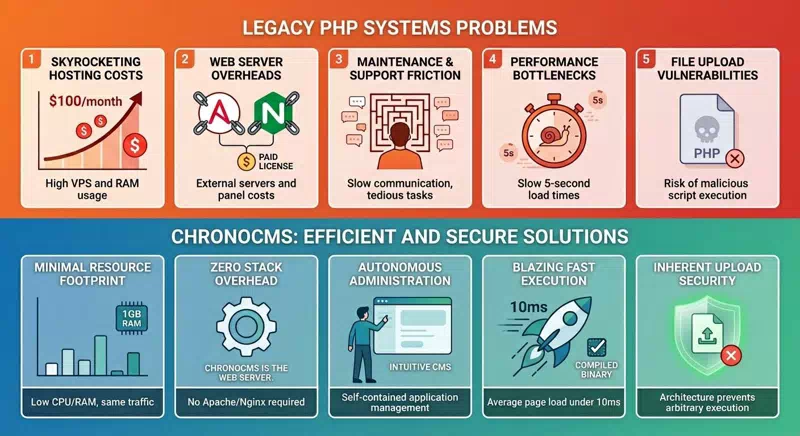
Over the past few years, we have been developing a custom, high-performance CMS to address the persistent infrastructure and performance challenges we faced with Joomla over the last decade. While Joomla served us well for a long time, scaling a modern community platform on a traditional architecture brought several critical pain points to light.
The Challenges of the Traditional PHP Stack
- Skyrocketing Hosting Costs: As our traffic grew—including heavy scraping from search engine bots—resource consumption spiked. By 2019, we were forced to scale up to an 8 GB RAM VPS costing $100 per month just to keep the website stable.
- Web Server Overheads: Because traditional content management systems rely on a standard PHP stack, they require an external web server like Apache or Nginx alongside a server management panel. When control panel licensing fees increased around 2021, it tacked on extra monthly overhead, driving hosting costs even higher.
- Maintenance & Support Friction: Managing routine server environment tasks through a traditional hosting provider became a major bottleneck. Simple operations—such as renewing paid SSL certificates ($50/year) or tweaking Apache settings and PHP extensions to optimize crawler speeds—required tedious back-and-forth discussions with support teams.
- Performance Bottlenecks: Under high traffic conditions, our homepage load times frequently climbed to 5 seconds. Resolving this on a standard PHP architecture required complex, aggressive caching layers like Varnish, which are notoriously difficult to manage on websites with highly dynamic content.
- File Upload Vulnerabilities: Inherent risks associated with traditional PHP file uploads mean that if a malicious script is successfully uploaded to a server, it can often be executed directly via its browser path, potentially compromising the entire website or server environment.
Discovering Go (Golang)
In 2022, we turned our attention to Go, the ultra-fast, high-performance programming language developed by Google. Go shines exceptionally bright in network and web server development. It became clear that Go was the perfect candidate for building a self-contained, high-performance web application capable of completely replacing the heavy, expensive, and difficult-to-manage PHP + Apache + Control Panel stack.
Following an intensive development phase to completely transition ChronoEngine's infrastructure, ChronoCMS was born. It handles every requirement natively, resolving our old architectural bottlenecks brilliantly.
How ChronoCMS Solves the Old Problems
- Minimal Resource Footprint: ChronoCMS runs seamlessly on just 1 vCPU and 1 GB of RAM, effortlessly handling the exact same traffic volume that previously strained our 8 GB RAM VPS.
- Zero Stack Overhead: ChronoCMS is the web server. There is no need to install, configure, or pay for Apache, Nginx, or a control panel. Everything is managed directly through the intuitive ChronoCMS administrative interface.
- Autonomous Administration: Because ChronoCMS operates as a single, self-contained application that performs all the heavy lifting, you do not need a team of systems experts or managed support contracts to handle server administration.
- Blazing Fast Execution: Unlike PHP, which must parse and interpret scripts on every single incoming request, ChronoCMS is compiled into a single, highly optimized binary executable (roughly 18 MB at the time of writing). It loads entirely into memory upon deployment, dropping average page processing times down to a stunning 10 milliseconds.
- Inherent Upload Security: Even if a malicious file is successfully uploaded to the system, the underlying architecture prevents arbitrary code execution, rendering traditional web-shell exploits completely harmless.
Enterprise Features Built Direct to the Core
Beyond solving foundational performance issues, ChronoCMS comes packed with a comprehensive suite of built-in tools designed to power modern web operations out of the box:
- In-Memory Caching: Caches frequent database structures and page layouts directly in RAM, resulting in up to a 70% reduction in page rendering times.
- Built-in Technical SEO: Generates clean, search-engine-friendly URLs out of the box with no .htaccess modifications or third-party extensions required. Customize any URL slug directly from the content editing screen.
- Native Multilingual & AI Support: Deliver content in as many languages as your audience demands, featuring integrated AI translation workflows right in the dashboard.
- One-Click Automated SSL: Provision, install, and automatically renew free Let's Encrypt SSL certificates with a single click.
- PostgreSQL Architecture: Built on top of PostgreSQL instead of MySQL to leverage superior query optimization, data integrity, and high-performance indexing.
- Visual Cron Task Scheduler: Automate periodic system tasks directly from the admin UI without needing access to the server command line.
- Secure File Manager: Browse, upload, and organize your website's media assets securely directly within the administrative dashboard.
- Integrated Forms Engine: Build, publish, and manage complex web forms leveraging the same deep flexibility and power found in ChronoForms 8.
- Advanced Email Analytics: Track every outbound email transactional log, including open rates and click-through metrics.
- Comprehensive Error Logging: Real-time automated logging of 404 errors, malicious path-traversal attempts, and unauthorized administrative access requests.
- Embedded Database Admin: Review, optimize, and manage your system's database tables securely without loading external utilities like phpMyAdmin.
Join the ChronoCMS Beta Test
ChronoCMS was built out of necessity to solve real-world scaling, security, and financial pressures. It has completely transformed how ChronoEngine runs, and now we want to share that performance jump with our community.
We are looking for users, developers, and site administrators to test-drive ChronoCMS and experience the speed firsthand.
Ready to see what 10ms page speeds look like? Create your demo site Here